What is work in Montessori?
When parents first tour a Montessori classroom, one word often catches them off guard: “work.”
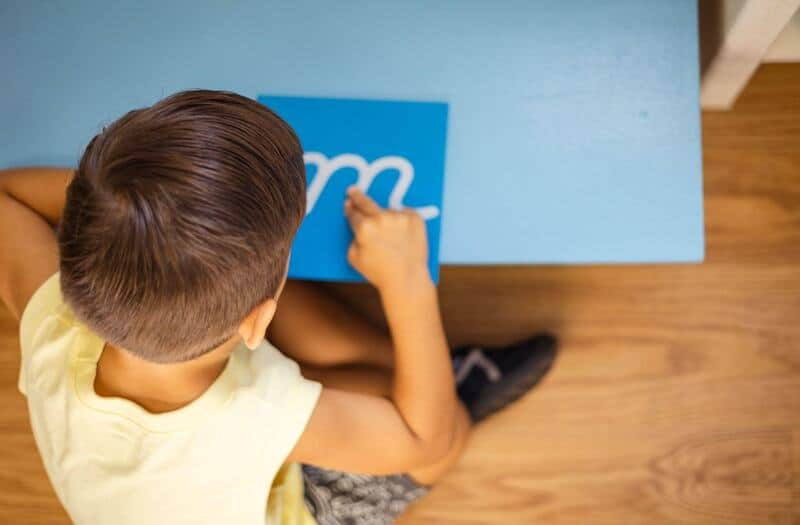
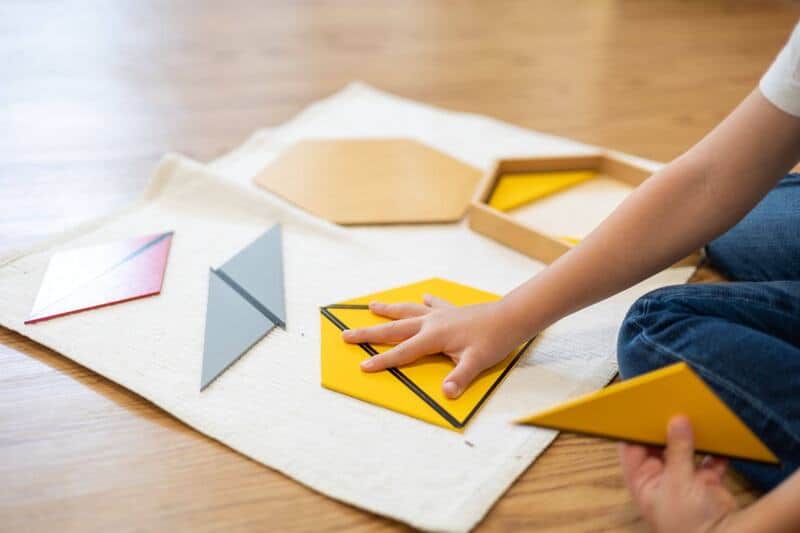
We watch a three-year-old carefully carry a heavy tray, polish a brass object, or scrub a table with soapy water, and we hear the teacher say, “Would you like to choose some work?” To adult ears, “work” sounds like a chore, an obligation, or something we do to earn a weekend off. It is easy to wonder if we are taking the joy out of childhood.
In an AMI Montessori environment, however, “work” carries a completely different meaning—one that honors the natural biological drives of childhood.
The Adult View vs. The Child’s View
To understand why Dr. Maria Montessori chose the word “work,” it helps to look at the difference between how adults and children experience effort:
- Adult Work: Driven by an external goal or outcome. We clean the kitchen to get it clean; we write a report to finish a project. Our goal is efficiency, and it’s product oriented..
- Adult Play: Recreation meant to relax the mind after work is done.
- The Child’s Work & Play: Driven by internal development. A child doesn’t scrub a table because the table is dirty and it needs to be cleaned. They scrub it because the process itself satisfies a deep developmental need to refine their movements, build concentration, and master a skill. It is not about the result at all.
For a young child, there is no artificial divide between play and effort. What adults call “play” is often the child’s serious effort to construct themselves and make sense of their world.
The Kitten Analogy: Play as Practice for Life
To understand why Dr. Maria Montessori chose the word “work,” it helps to look at nature.
Think about a kitten pouncing on a trailing piece of yarn or chasing its own tail. To an outside observer, the kitten is “just playing.” There is no practical outcome; no mouse is being caught for dinner. But biologically, that play is deadly serious. It is an instinctual dress rehearsal for adulthood—a natural mechanism to hone reaction times, refine spatial judgment, and build muscle control. Play as work.
Why We Call It “Work”
Calling activities in a Montessori classroom “work” isn’t about imposing adult burdens on children. It is about dignity and respect.
When we label a child’s concentrated effort as “just playing,” we unintentionally diminish its importance. Calling it “work” acknowledges that carrying a heavy jug of water without spilling requires real physical effort, intense focus, and problem-solving. It signals to the child that their activity is meaningful, valued, and respected by the community.
The Joy of Purposeful Activity
True joy for a child doesn’t come from passive entertainment or instant gratification. It comes from purposeful effort.
When a child chooses an activity, engages with it deeply, and carries it through to completion, something remarkable happens. They enter a state of deep concentration. Afterward, rather than looking exhausted, the child emerges rested, calm, and visibly proud.
This deep satisfaction comes from several key elements of Montessori work:
- Choice: Children choose their own work from materials they have been presented, fostering true ownership.
- Real Purpose: Montessori materials aren’t pretend. Children use real glass, real water, real polish, and real tools. Doing authentic tasks builds genuine self-worth.
- Control of Error: The materials are designed so children can see and correct their own mistakes without an adult pointing them out, building problem-solving confidence.
Supporting “Work” at Home
You don’t need a classroom full of specialized materials to bring this mindset home. You can support your child’s natural drive to work by involving them in real household life:
- Invite them to pour their own water, peel bananas, or sweep up spills.
- Slow down and let them complete a task at their own pace, resisting the urge to take over when they struggle.
- Acknowledge their effort rather than showering them with praise (e.g., “You worked on that puzzle for a long time!” instead of “Good job!”).
When we reframe our idea of “work,” we stop seeing children’s effort as burdensome and start seeing it for what it truly is: the joyful, self-directed construction of a capable human being.
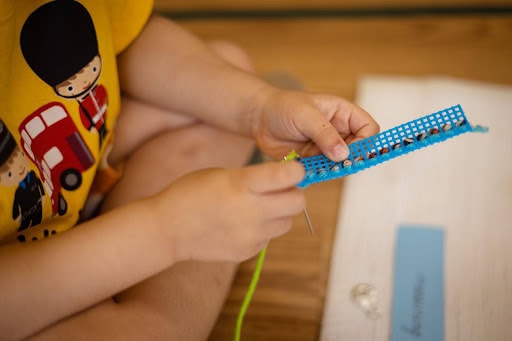 | 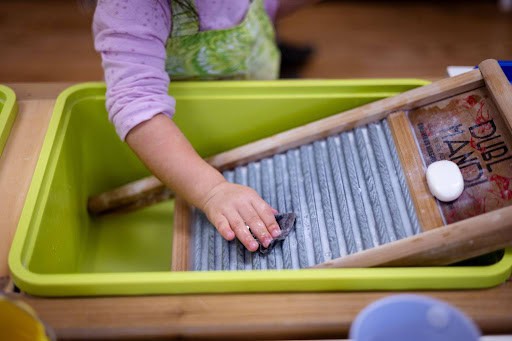 | |
The little things matter | Real Responsibility | |
| Children take pride in doing “real” things — sewing an actual bookmark they can use for bedtime reading. | When children wash cloths from the classroom, they know they are contributing to their community. |