
Where Each Child’s Unique Potential Is Celebrated
An education built on scientific observation, prepared environments, and deep respect for the natural development of every child.
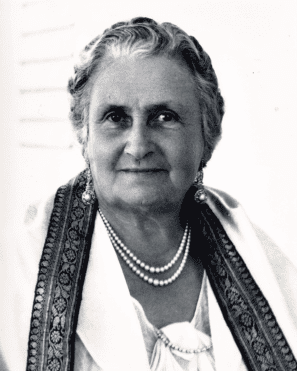
Founder of the Montessori Movement
Dr. Maria Montessori
Maria Montessori was the first woman to practice medicine in Italy. A scholar of biology, psychiatry, anthropology, and medicine, she graduated from the Faculty of Medicine at the University of Rome in 1896. As a physician, Dr. Montessori was in touch with young children and became profoundly interested in their development. Through careful and exhaustive scrutiny, she realized that children construct their own personalities as they interact with their environment. She also observed the manner in which they learned as they spontaneously chose and worked with the auto didactic materials she provided.
She studied children of all races and cultures in many countries around the world, soon seeing the universality of the laws of human development. She continued her observations throughout her life, widening and deepening her understanding until her death in 1952. Also a devoted humanitarian, she was three-times nominated for the Nobel Peace Prize for her advocacy efforts toward a more peaceful humanity.
Maria Montessori was a scientist, and as a good scientist, she was earth-bound and highly spiritual in her pursuit of truth. Through her studies of educational methods, she declared two principles as the foundation of Montessori pedagogy: the universal characteristics of the human child, and the child as a unique, unrepeatable, respectable, and admirable individual to be unconditionally accepted as one of life’s most marvelous expressions.
A Global Movement
From One Classroom to the World
The Montessori method has since spread to nearly every country throughout the world. The movement reached the United States in 1963. Although it initially spread slowly throughout the U.S., the number of Montessori schools has doubled over the past ten years.
Accredited Montessori schools nationwide
Students educated annually in the U.S.
Public schools with Montessori magnet programs
Continuing Maria Montessori’s Vision
Why AMI?
AMI is the acronym for the Association Montessori Internationale, the organization that Dr. Montessori established in 1929 to protect the integrity of her work. Unfortunately, “Montessori” is not a patented name. The AMI designation is internationally recognized as the highest standard of quality with regards to a Montessori school.
AMI has set standards for Montessori classrooms. These standards include:

A Trained Teacher
There will be one AMI trained teacher at the appropriate age level in each class.

Complete Materials
Each class must be equipped with a full complement of Montessori materials from an approved AMI manufacturer.

A Balance of Ages
Each class will include a well-balanced division of ages within the appropriate age range, as well as a suitable number of children.

Uninterrupted Work
Each primary and elementary class will have prolonged uninterrupted work periods of 3 hours in the morning and 2 to 3 hours in the afternoon.
These standards are in keeping with Dr. Montessori’s teachings, and they provide the structure for the establishment of a true, high quality Montessori school.
Your Child’s Best Years Start Here
Visit our Charlotte campus, meet our teachers, and see authentic Montessori in action.